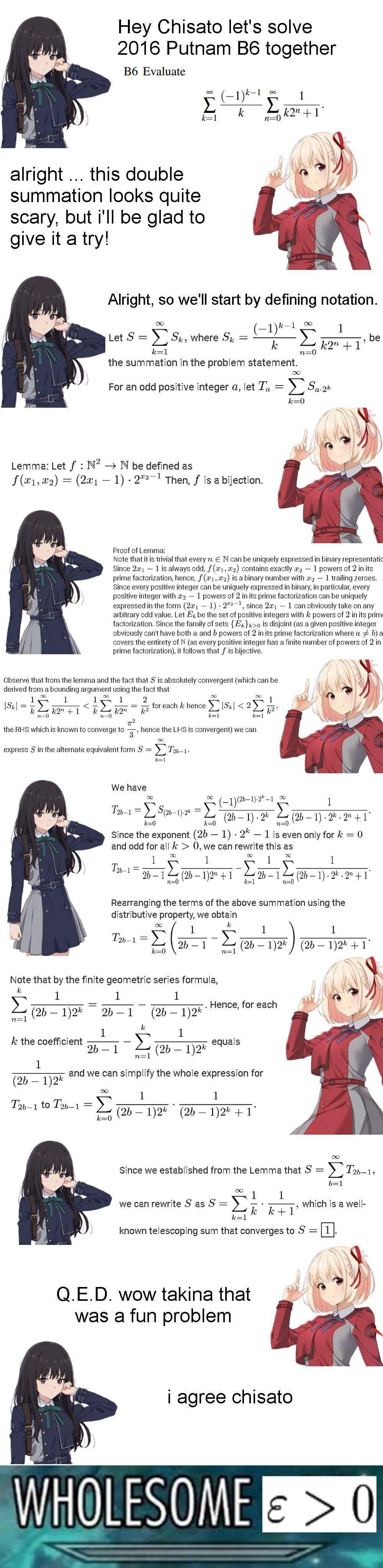
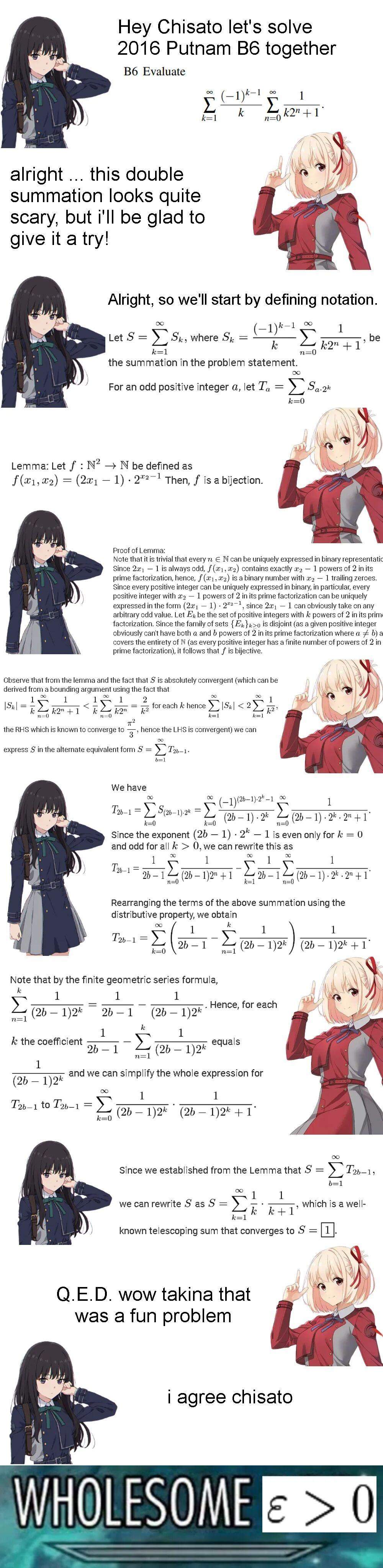
莉可丽丝二人组联手攻克普特南数学B6题
对白
文本内容
B6 Evaluate
$∑{k=1}^{∞} (-1)^{k-1}/k ∑ 1/(k2^n + 1)$}^{∞
Let $S = ∑{k=1}^{∞} S_k$, where $S_k = (-1)^{k-1}/k ∑ 1/(k2^n + 1)$, be the summation in the problem statement.}^{∞
For an odd positive integer $a$, let $T_a = ∑{k=0}^{∞} S$
Lemma: Let $f : \mathbb{N}^2 \to \mathbb{N}$ be defined as $f(x_1,x_2)=(2x_1-1)\cdot2^{x_2-1}$ Then, $f$ is a bijection.
Proof of Lemma:
Note that it is trivial that every $n \in \mathbb{N}$ can be uniquely expressed in binary representation. Since $2x_1 - 1$ is always odd, $f(x_1,x_2)$ contains exactly $x_2 - 1$ powers of 2 in its prime factorization, hence, $f(x_1,x_2)$ is a binary number with $x_2 - 1$ trailing zeroes. Since every positive integer can be uniquely expressed in binary, in particular, every positive integer with $x_2 - 1$ powers of 2 in its prime factorization can be uniquely expressed in the form $(2x_1 - 1) \cdot 2^{x_2-1}$, since $2x_1 - 1$ can obviously take on any arbitrary odd value. Let $E_k$ be the set of positive integers with $k$ powers of 2 in its prime factorization. Since the family of sets ${E_k}_{k\geq0}$ is disjoint (as a given positive integer obviously can't have both $a$ and $b$ powers of 2 in its prime factorization where $a \neq b$) and covers the entirety of $\mathbb{N}$ (as every positive integer has a finite number of powers of 2 in prime factorization), it follows that $f$ is bijective.
Observe that from the lemma and the fact that $S$ is absolutely convergent (which can be derived from a bounding argument using the fact that $|S_k| = \frac{1}{k}\sum_{n=0}^{\infty}\frac{1}{k2^n +1} < \frac{1}{k}\sum_{n=0}^{\infty}\frac{1}{k2^n} = \frac{2}{k^2}$ hence $\sum_{k=1}^{\infty}|S_k| < 2\sum_{k=1}^{\infty}\frac{1}{k^2}$, the RHS which is known to converge to $\frac{\pi^2}{3}$, hence the LHS is convergent) we can express $S$ in the alternate equivalent form $S = \sum_{b=1}^{\infty} T_{2b-1}$.
We have
$T_{2b-1} = \sum_{k=0}^{\infty} S_{(2b-1)\cdot2^k} = \sum_{k=0}^{\infty} \frac{(-1)^{(2b-1)\cdot2^k -1}}{(2b-1)\cdot2^k} \sum_{n=0}^{\infty} \frac{1}{(2b-1)\cdot2^k \cdot 2^n +1}$.
Since the exponent $(2b-1)\cdot2^k -1$ is even only for $k=0$ and odd for all $k>0$, we can rewrite this as
$T_{2b-1} = \frac{1}{2b-1}\sum_{n=0}^{\infty}\frac{1}{(2b-1)2^n +1} - \sum_{k=1}^{\infty}\frac{1}{(2b-1)\cdot2^k}\sum_{n=0}^{\infty}\frac{1}{(2b-1)\cdot2^k \cdot 2^n +1}$.
Rearranging the terms of the above summation using the distributive property, we obtain
$T_{2b-1} = \sum_{k=0}^{\infty} \left( \frac{1}{2b-1} - \sum_{n=1}^{k}\frac{1}{(2b-1)2^n} \right) \frac{1}{(2b-1)2^k +1}$.
Note that by the finite geometric series formula,
$\sum_{n=1}^{k}\frac{1}{(2b-1)2^n} = \frac{1}{2b-1} - \frac{1}{(2b-1)2^k}$. Hence, for each
$k$ the coefficient $\frac{1}{2b-1} - \sum_{n=1}^{k}\frac{1}{(2b-1)2^n}$ equals
$\frac{1}{(2b-1)2^k}$ and we can simplify the whole expression for
$T_{2b-1}$ to $T_{2b-1} = \sum_{k=0}^{\infty} \frac{1}{(2b-1)2^k} \cdot \frac{1}{(2b-1)2^k +1}$.
Since we established from the Lemma that $S = \sum_{b=1}^{\infty} T_{2b-1}$,
we can rewrite $S$ as $S = \sum_{k=1}^{\infty} \frac{1}{k} \cdot \frac{1}{k+1}$, which is a well-known telescoping sum that converges to $S = \boldsymbol{1}$.
底部文字:WHOLESOME ε>0
整体描述
这是一张二次元科普向二次创作连环meme,使用动画《莉可丽丝》中的角色锦木千束与井上泷奈的截图,模拟两人协作解决2016年普特南数学竞赛B6题的全过程。从最初觉得双重求和题目吓人,到一步步定义数学符号、证明双射引理、转换求和形式,最终将原式转化为望远镜求和得出结果为1。结尾两人感慨解题有趣,底部的"WHOLESOME ε>0"结合了数学中小量符号ε>0与英文"wholesome(治愈)"玩了数学梗,让硬核数学内容变得轻松有趣。
来源说明
角色出自2022年播出的原创电视动画《莉可丽丝》(Lycoris Recoil),这张图是网友将动画角色截图与专业数学解题过程拼接制作的二次创作内容,这类meme常出现在Reddit的数学梗社区、二次元论坛等平台,通过二次元角色降低硬核数学内容的门槛,兼具趣味性与知识性。