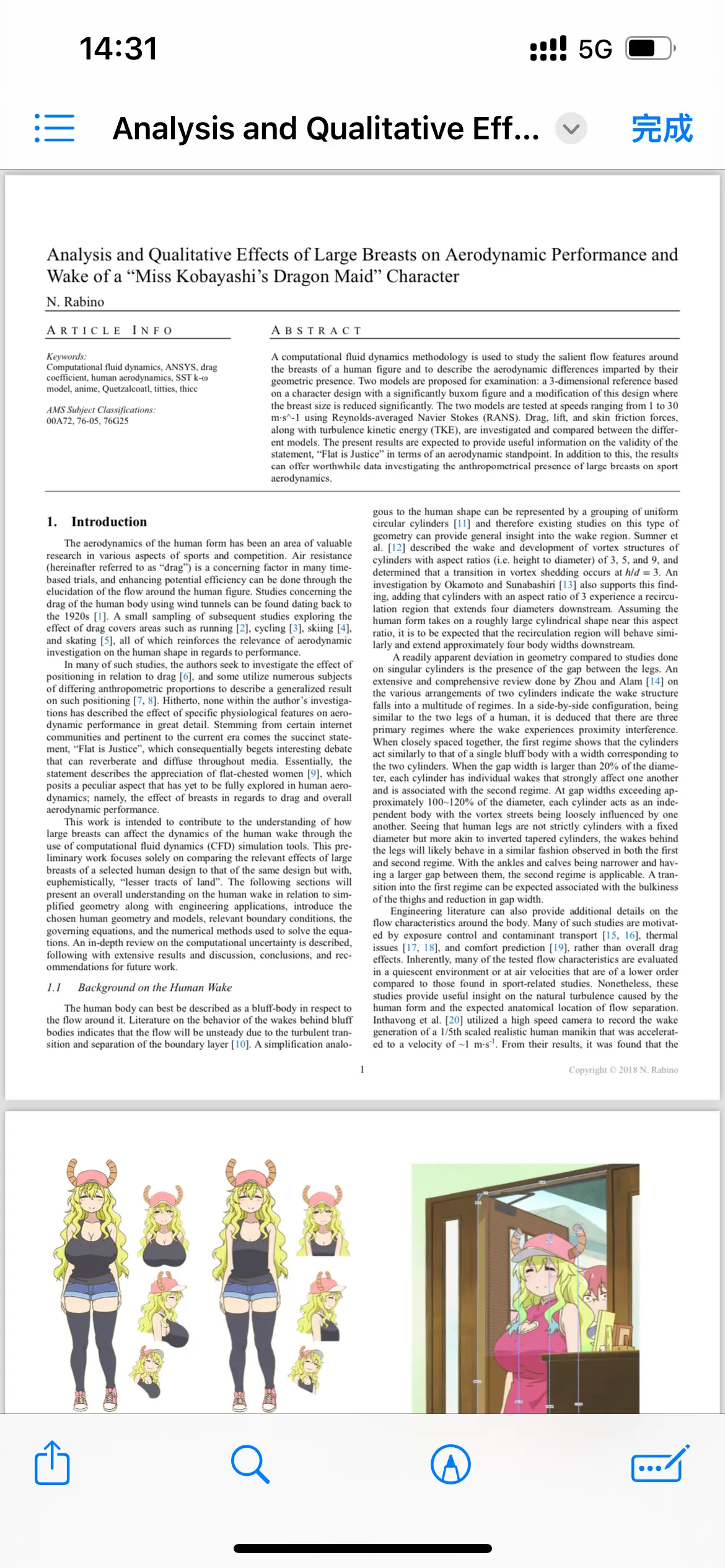
学术论文研究《小林家的龙女仆》角色胸部对气动性能的影响
文本内容
论文标题:Analysis and Qualitative Effects of Large Breasts on Aerodynamic Performance and Wake of a "Miss Kobayashi's Dragon Maid" Character
作者:N. Rabino
ARTICLE INFO
Keywords:
Computational fluid dynamics, ANSYS, drag coefficient, human aerodynamics, SST k-ω model, anime, Quetzalcoatl, titties, thicc
AMS Subject Classifications:
00A72, 76-05, 76G25
ABSTRACT
A computational fluid dynamics methodology is used to study the salient flow features around the breasts of a human figure and to describe the aerodynamic differences imparted by their geometric presence. Two models are proposed for examination: a 3-dimensional reference based on a character design with a significantly buxom figure and a modification of this design where the breast size is reduced significantly. The two models are tested at speeds ranging from 1 to 30 m·s^-1 using Reynolds-averaged Navier Stokes (RANS). Drag, lift, and skin friction forces, along with turbulence kinetic energy (TKE), are investigated and compared between the different models. The present results are expected to provide useful information on the validity of the statement, "Flat is Justice" in terms of an aerodynamic standpoint. In addition to this, the results can offer worthwhile data investigating the anthropometrical presence of large breasts on sport aerodynamics.
- Introduction
The aerodynamics of the human form has been an area of valuable research in various aspects of sports and competition. Air resistance (hereinafter referred to as "drag") is a concerning factor in many time-based trials, and enhancing potential efficiency can be done through the elucidation of the flow around the human figure. Studies concerning the drag of the human body using wind tunnels can be found dating back to the 1920s [1]. A small sampling of subsequent studies exploring the effect of drag covers areas such as running [2], cycling [3], skiing [4], and skating [5], all of which reinforces the relevance of aerodynamic investigation on the human shape in regards to performance.
In many of such studies, the authors seek to investigate the effect of positioning in relation to drag [6], and some utilize numerous subjects of differing anthropometric proportions to describe a generalized result on such positioning [7, 8]. Hitherto, none within the author's investigations has described the effect of specific physiological features on aerodynamic performance in great detail. Stemming from certain internet communities and pertinent to the current era comes the succinct statement, "Flat is Justice", which consequentially begets interesting debate that can reverberate and diffuse throughout media. Essentially, the statement describes the appreciation of flat-chested women [9], which posits a peculiar aspect that has yet to be fully explored in human aerodynamics; namely, the effect of breasts in regards to drag and overall aerodynamic performance.
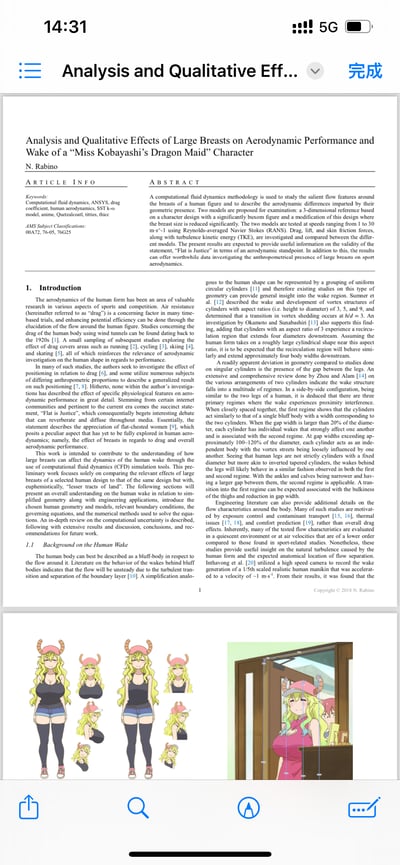
This work is intended to contribute to the understanding of how large breasts can affect the dynamics of the human wake through the use of computational fluid dynamics (CFD) simulation tools. This preliminary work focuses solely on comparing the relevant effects of large breasts of a selected human design to that of the same design but with, euphemistically, "lesser tracts of land". The following sections will present an overall understanding on the human wake in relation to simplified geometry along with engineering applications, introduce the chosen human geometry and models, relevant boundary conditions, the governing equations, and the numerical methods used to solve the equations. An in-depth review on the computational uncertainty is described, following with extensive results and discussion, conclusions, and recommendations for future work.
1.1 Background on the Human Wake
The human body can best be described as a bluff-body in respect to the flow around it. Literature on the behavior of the wakes behind bluff bodies indicates that the flow will be unsteady due to the turbulent transition and separation of the boundary layer [10]. A simplification analogous to the human shape can be represented by a grouping of uniform circular cylinders [11] and therefore existing studies on this type of geometry can provide general insight into the wake region. Sumner et al. [12] described the wake and development of vortex structures of cylinders with aspect ratios (i.e. height to diameter) of 3, 5, and 9, and determined that a transition in vortex shedding occurs at h/d = 3. An investigation by Okamoto and Sunabashiri [13] also supports this finding, adding that cylinders with an aspect ratio of 3 experience a recirculation region that extends four diameters downstream. Assuming the human form takes on a roughly large cylindrical shape near this aspect ratio, it is to be expected that the recirculation region will behave similarly and extend approximately four body widths downstream.
A readily apparent deviation in geometry compared to studies done on singular cylinders is the presence of the gap between the legs. An extensive and comprehensive review done by Zhou and Alam [14] on the various arrangements of two cylinders indicate the wake structure falls into a multitude of regimes. In a side-by-side configuration, being similar to the two legs of a human, it is deduced that there are three primary regimes where the wake experiences proximity interference. When closely spaced together, the first regime shows that the cylinders act similarly to that of a single bluff body with a width corresponding to the two cylinders. When the gap width is larger than 20% of the diameter, each cylinder has individual wakes that strongly affect one another and is associated with the second regime. At gap widths exceeding approximately 100~120% of the diameter, each cylinder acts as an independent body with the vortex streets being loosely influenced by one another. Seeing that human legs are not strictly cylinders with a fixed diameter but more akin to inverted tapered cylinders, the wakes behind the legs will likely behave in a similar fashion observed in both the first and second regime. With the ankles and calves being narrower and having a larger gap between them, the second regime is applicable. A transition into the first regime can be expected associated with the bulkiness of the thighs and reduction in gap width.
Engineering literature can also provide additional details on the flow characteristics around the body. Many of such studies are motivated by exposure control and contaminant transport [15, 16], thermal issues [17, 18], and comfort prediction [19], rather than overall drag effects. Inherently, many of the tested flow characteristics are evaluated in a quiescent environment or at air velocities that are of a lower order compared to those found in sport-related studies. Nonetheless, these studies provide useful insight on the natural turbulence caused by the human form and the expected anatomical location of flow separation. Inthavong et al. [20] utilized a high speed camera to record the wake generation of a 1/5th scaled realistic human manikin that was accelerated to a velocity of ~1 m·s^-1. From their results, it was found that the
整体描述
这是一张手机屏幕截图,展示了一篇2018年发布的趣味学术论文,标题为《Analysis and Qualitative Effects of Large Breasts on Aerodynamic Performance and Wake of a "Miss Kobayashi's Dragon Maid" Character》,作者为N. Rabino。论文采用计算流体动力学(CFD)方法,对比了《小林家的龙女仆》中魁札尔科亚特尔(露科亚)的两种胸部尺寸模型的气动特性(包括阻力、升力、湍流动能等),还探讨了二次元梗“Flat is Justice”在空气动力学角度的合理性。截图下方附带了该角色的多视角形象图,直观展示了论文的研究对象。
来源说明
这篇论文是由N. Rabino撰写的跨界趣味学术研究,2018年正式发布,将二次元角色与空气动力学结合,在学术圈和二次元爱好者圈子中流传。截图来自手机端的论文阅读界面,下方的角色图出自动画《小林家的龙女仆》,为动画原始角色形象。